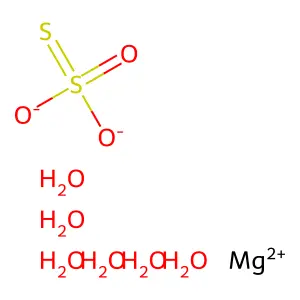
Magnesium sulfate heptahydrate — Epsom salt — is one of the most frequently used inorganic salts in laboratory practice, where it serves as the default drying agent for organic extracts, a magnesium source in synthesis, and a standard component of buffer and culture systems. The same compound supports large-scale applications in agriculture, nutrition, and industrial processes.
Chemical Identity and Key Properties
| Property | Value |
|---|---|
| CAS Number | 10034-99-8 |
| Molecular Formula | H14MgO11S |
| Molecular Weight | 246.01 g/mol |
| Density | 1.68 @25 °C |
| Typical Purity | ≥98%, 98.0-102.0% (ACS specification) |
Laboratory and Synthesis Uses
Drying Organic Phases
The heptahydrate is the workhorse neutral drying agent for ethereal and ester extracts: fast, coarse, easy to filter, and forgiving of acidic substrates. Its capacity for water is modest (the monohydrate is the end state at ambient drying), so best practice is a preliminary bulky pre-dry before the polish step.
Magnesium Source in Chemistry
From Grignard initiation support and magnesiation chemistry to precipitation protocols and sulfate/buffer systems, the salt is a convenient, safe Mg2+ vehicle.
Biochemical Media
Defined culture media use MgSO4·7H2O as the standard magnesium supplement at defined ionic strength.
Industrial and Agricultural Applications
In agriculture, magnesium sulfate corrects Mg deficiency in high-value crops and fertigation systems. Industrial uses include pulp-and-paper processing, textile dyeing, cement set-modifiers, and bath-salt/personal-care formulations.
Specifications and Storage
ACS-grade material meets defined assays (98.0–102.0% MgSO4·7H2O) with controlled insolubles, chloride, and heavy-metal limits; technical grades cover agricultural pricing tiers. The hydrate is stable in sealed containers but will cake or partially dehydrate under dry-heat or low-humidity extremes — store cool and sealed.
Frequently Asked Questions
Why is magnesium sulfate preferred over sodium sulfate for drying?
It acts faster than anhydrous sodium sulfate and suits acidic or fine-solid-sensitive workups; sodium sulfate holds more water per gram but dries more slowly.
What does ACS specification actually verify?
Assay within 98.0–102.0%, plus limits on insoluble matter, pH behavior, and trace metals — the appropriate choice for analytical and synthesis-critical workflows.
Can CoreyChem supply both reagent and agricultural grades?
Yes — multiple grades from ACS reagent to technical/agricultural scale are available with COA per lot.
Source from CoreyChem
CoreyChem supplies Magnesium Sulfate Heptahydrate (CAS 10034-99-8) with lot-specific COA and MSDS documentation. Custom synthesis, higher purity grades, and bulk packaging are available on request — contact our technical team with your target specification and quantity for current lead time and pricing.