Global corrosion costs are staggering—approximately USD 2.5 trillion annually, equivalent to 3.4% of global GDP, according to the NACE International IMPACT study. In China alone, marine corrosion causes economic losses exceeding RMB 300 billion per year.
Anticorrosion coatings are the first line of defense. The global anticorrosion coatings market reached approximately USD 35-37 billion in 2025 and is projected to reach USD 51-61 billion by 2034 [SRC-001]. Epoxy-based anticorrosion coatings command the largest market share—owing to their superior adhesion, chemical resistance, and mechanical strength.
Yet traditional epoxy coatings face three increasingly urgent challenges:
1. Chromate pigment bans: Hexavalent chromium (strontium/zinc chromate), the core inhibitive pigment in traditional primers, is listed as an SVHC under REACH and RoHS. Global phase-out deadlines are approaching.
2. Physical barrier limitations: Traditional epoxy relies primarily on physical blocking. A single microcrack or mechanical scratch opens a direct path for corrosive media.
3. Performance degradation under extreme conditions: Combined high temperature, high salt spray, and acidic gases dramatically shorten the service life of single-function epoxy systems.
These converge on one technological direction: developing multifunctional coating systems that integrate physical barrier, chemical adsorption, and self-healing capabilities.
Phosphazene-Based Epoxy Coatings: Experimentally Validated Next-Generation Candidates
A 2024 comprehensive review in MDPI *Polymers* documented a remarkable finding: cyclophosphazene-derived epoxy resins demonstrate near-perfect anticorrosion efficiency on metal substrates [SRC-002].
Core Data: HPGCP Protection Performance
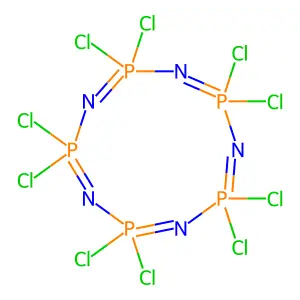
Hexaglycidyl cyclotriphosphazene (HPGCP)—a hexafunctional epoxy monomer synthesized from hexachlorocyclotriphosphazene (HCCP) and glycidol—is the most thoroughly studied phosphazene-based anticorrosion material. Its protection data on carbon steel and copper substrates is impressive [SRC-002, SRC-003]:
| Substrate | Corrosive Medium | Protection Efficiency | Concentration |
|---|---|---|---|
| Carbon Steel (CS) | 1M HCl | **97%** | 10⁻⁵ M |
| Carbon Steel (CS) | 3% NaCl | **99%** | — |
| Copper (Cu) | 3% NaCl | **95%** (PDP) / **96.42%** (EIS) | 10⁻³ M |
A protection efficiency of 99% in 3% NaCl—near seawater salinity—means corrosion of carbon steel is suppressed to a virtually negligible level.
Why Are Phosphazene Coatings So Effective?
The inhibition mechanism of HPGCP extends far beyond simple physical barrier effects. Molecular dynamics (MD) simulations have revealed multi-layered synergistic protection [SRC-002, SRC-003]:
1. Chemisorption: Nitrogen atoms and π-electrons in HPGCP donate lone-pair electrons to empty d-orbitals of metal surface atoms (Fe/Cu), forming coordination bonds—several orders of magnitude stronger than van der Waals forces. MD simulations confirm HPGCP adopts a horizontal adsorption configuration, maximizing single-molecule surface coverage.
2. Crosslinked film formation: Multiple epoxy groups react with curing agents to form a highly crosslinked three-dimensional network, providing a denser physical barrier layer than conventional bisphenol-A epoxy.
3. Phosphorus passivation effect: Phosphorus atoms form iron/copper phosphate passivation films on metal surfaces—analogous to a microscopic phosphating treatment—an effect entirely absent in traditional organic coatings.
OCCP's Unique Advantage in Anticorrosion: 8 Epoxy "Arms"
All HPGCP data is based on cyclotriphosphazene (HCCP, 6 epoxy groups). But the core parameter governing anticorrosion coating performance—crosslink density—is directly proportional to the number of epoxy groups per molecule.
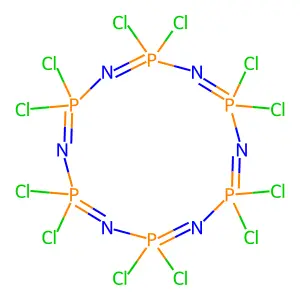
OCCP possesses 8 substitutable P-Cl sites, theoretically convertible to octaglycidyl cyclotetraphosphazene (OGCP)—each molecule carrying 8 epoxy groups, 33% more than HPGCP.
OCCP-8F vs. HCCP-6F: Theoretical Impact on Coating Properties
| Coating Property | HCCP-6 Epoxy (HPGCP) | OCCP-8 Epoxy (OGCP, theoretical) | Improvement |
|---|---|---|---|
| Epoxy groups per molecule | 6 | **8** | **+33%** |
| Theoretical crosslink density | Baseline | **Higher** | Denser barrier layer |
| P/N atom density | Baseline | **Higher** | More chemisorption sites |
| Passivating P atoms per molecule | 3 | **4** | **+33%** |
| Single-molecule coverage area | Baseline | **Larger** (8-membered ring) | Higher adsorption efficiency |
| Glass transition temperature (Tg) | Baseline | **Higher** (predicted) | Better thermal stability |
These theoretical advantages translate into practical coating formulation benefits:
- Lower curing agent dosage (more crosslinking sites per molecule at equivalent epoxy equivalent weight)
- Higher heat resistance (denser crosslink network → higher Tg)
- Stronger metal adhesion and chemisorption (more N-atom coordination sites and richer π-electron systems)
Why Now? Three Transformation Windows in Anticorrosion Coatings
Window 1: Chrome-Free Regulatory Mandates Driving Formulation Overhaul
EU REACH has listed strontium/zinc chromate in Annex XIV (Authorization List), requiring cessation after sunset dates. China's VOC governance policies are simultaneously pushing the coatings industry toward high-solids, solvent-free, and waterborne systems.
This means tens of thousands of tons of chromate-containing anticorrosion primer formulations must be redesigned within 5-10 years globally. Phosphazene-based multifunctional epoxy resins—combining chemisorption inhibition with physical barrier functionality—are strong candidates to fill this gap.
Window 2: Ultra-Long Service Life Demands from Offshore Engineering
Offshore wind turbine towers, sea-crossing bridges, and subsea pipelines now demand 50-100 year anticorrosion design life. Traditional zinc-rich epoxy primers typically provide only 15-20 years of effective protection in marine splash zones. Phosphazene-based coatings, through their triple mechanism of "chemisorption + physical barrier + phosphorus passivation," theoretically enable longer maintenance-free intervals.
Window 3: OCCP's 8-Arm Architecture Falls in the Coatings "Sweet Spot"
An empirical rule in coatings chemistry: epoxy resins with functionality between 4 and 8 achieve optimal coating property balance—lower functionality yields insufficient crosslink density; higher functionality (>10) increases coating brittleness. OCCP's 8 functionalizable sites sit precisely at the upper bound of this sweet spot.
🛒 Product Featured in This Article
🛒 Product Featured in This Article
Octachlorocyclotetraphosphazene (CAS 2950-45-0)
Formula: Cl₈N₄P₄ | MW: 459.66 | Purity: ≥98%
100 kg to metric-ton stable supply
🛒 Product Featured
Octachlorocyclotetraphosphazene (CAS 2950-45-0)
Formula: Cl₈N₄P₄ | MW: 459.66 | Purity: ≥98%
100 kg to metric-ton stable supply
Take Action: Next-Generation Anticorrosion Epoxy Precursors Start with OCCP
CoreyChem (Career Henan Chemical Co.) operates a mature production process for octachlorocyclotetraphosphazene, from gram to metric-ton scale.
- 🏭 100 kg to ton-scale stable supply — In-house production
- 💰 Cost-efficient process — Optimized CoCl₂-catalyzed route
- 🔬 Batch-to-batch consistency — COA included, HPLC/GC/³¹P NMR available
- 🧪 Academic collaboration fast track — Priority samples
We invite research teams and companies in the following areas:
- Phosphazene-based epoxy resin synthesis and anticorrosion formulation development
- Chrome-free anticorrosion primer inhibitor/film-former alternatives
- Multifunctional epoxy precursors for heavy-duty marine coatings
- Chemisorption-type corrosion inhibitor design and evaluation
Protecting metal—starting from the precise chemistry of 8 P-Cl bonds.
- 📧 Email: [email protected]
- 📞 Tel: +86-0371-86658258
- 🌐 Product Page: https://www.careerchemical.com/product/2950-45-0